Overview
I recently took a trip officially called Northern Spain and Portugal: Pilgrimage into the Past. I’m no secret fan of Overseas Adventure Travel (OAT); I have traveled with them before and continue to book trips with them. Check out my affiliate’s page for details.
The second part of the trip’s name is important. During most of the trip, we were near or on the Camino de Santiago, a Christian pilgrimage route dating back centuries. Known by other names, such as the Road to Santiago or simply The Way, thousands of people travel it every year.
The Basques in Northern Spain
Like several countries, Spain has regional differences. Visiting Northern Spain and Portugal is different from visiting Madrid or Southern Spain. Besides food, Northern Spain is the Basque Country.
In Italy, for example, there are regional dialects, but it is still all Italian. The Basque language is different from Spanish. In fact, the Basques speak a language unlike any other European language. The separatist movement, led by the group known as ETA, has been replaced by acceptance of autonomous rule. However, you will see displays advocating the incarceration of political prisoners in the Basque Country.
The Spanish Civil War and Fransico Franco
Another major influence was the Spanish Civil War and the Franco regime. From his coup in 1936 until he died in 1975, Francisco Franco ruled Spain with an iron fist. We visited Gernika (or Guernica), the site of the first instance of deliberate aerial bombing of civilians with no military objective. We saw a statue commemorating the silent protest of two sisters against Franco’s rule in a park in Santiago. Feelings are just below the surface, especially in the older generation.
Away from the tourists
From learning how bees make honey to how horses are used to treat physical handicaps, to how to make talo, a Basque corn flatbread, to how to pour the traditional wine, Learning and discovery are key to OAT trips.
History of Northern Spain and Portugal
As the name implies, history was a major piece of the trip. Walking across a Roman bridge and seeing a castle built to defend Portugal’s first city. Visiting a medieval covered market street in Santiago. Eating at a restaurant in the same family since the early 1800s.
Conclusion
This article is just the highlights of the trip; I will have many articles about the places and sites we visited. Check the website regularly, or better, sign up for my update newsletter.
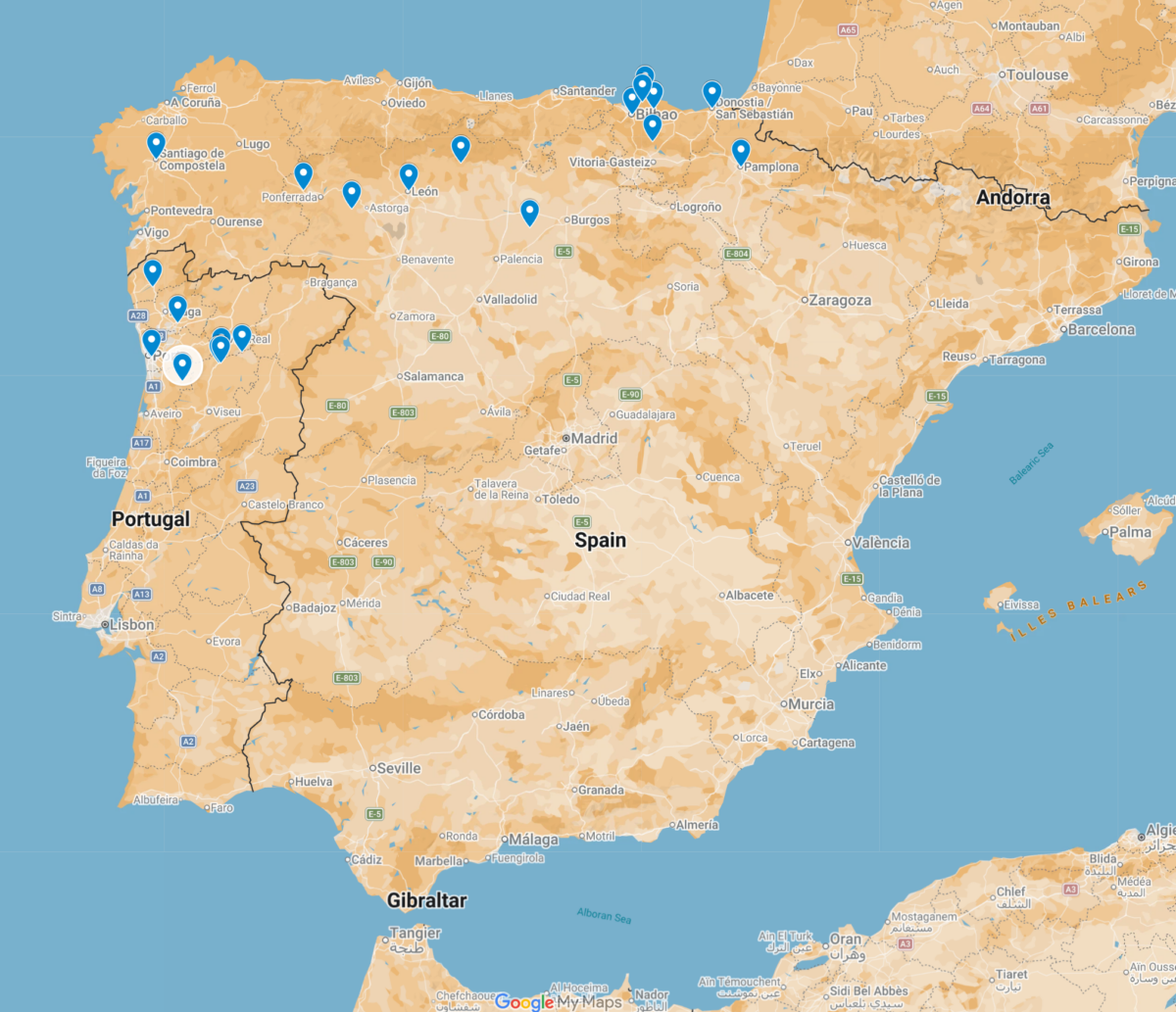
Here is a map showing where we visited. Click on the map for an interactive version.